Science News
 American
Science News for 16 October 2012
American
Science News for 16 October 2012
Interactive Fractal Tree of Life Zooms In On Earth's Entire Evolutionary History
Popular Science - 16 Oct 2012 23:00 A new interactive website shows a phylogenetic tree of everything, as zoomable as Google Earth. From protozoans to people, there is a lot of life on this planet, and it’s all connected to a common ancestor from wh...
Mystery particles on Mars revealed by rover's litter
New Scientist - 16 Oct 2012 22:33
A plastic wrapper dropped by Curiosity has prompted the rover team to take a closer look at mysterious bright bits in the surrounding soil
Robo-Wheelchair Climbs Stairs! [Video]
Popular Science - 16 Oct 2012 22:00![Robo-Wheelchair Climbs Stairs! [Video]](http://www.popsci.com/files/imagecache/article_image_large/articles/wheelup.png) The robotic wheelchair senses the topography of a surface and decides whether to roll across it, or walk. Wheels are the most efficient way to get around, but they can't take you everywhere. This new robotic wheelchair d...
The robotic wheelchair senses the topography of a surface and decides whether to roll across it, or walk. Wheels are the most efficient way to get around, but they can't take you everywhere. This new robotic wheelchair d...
Video: The 'World's First High-Speed, Commercially Available Amphibious Vehicle'
Popular Science - 16 Oct 2012 20:00 The first commercially available amphibious vehicle capable of decent speeds--45 miles per hour on both land and water--is expected to go on sale in the U.S. by the end of this year. At $40,000 a pop, the Quadski is an e...
Today on New Scientist: 16 October 2012
New Scientist - 16 Oct 2012 19:00
All today's stories on newscientist.com, inlcuding: Ada Lovelace, promising new cancer treatments, shocking underpants, and more
Scrap Metal Reborn As Awesome Sci-Fi Robots By Passionate Math Professor
Singularity Hub - 16 Oct 2012 18:29 Tal Avitzur may be a math professor, but one look at his workshop reveals his other passion: scrap metal robots. For the last few years, he’s been finding other’s people junk and turning them into robot-...
Triceratops: Facts About the Three-Horned Dinosaur
Live Science - 16 Oct 2012 18:00 The dinosaur with the fearsome face was a gentle giant.
New Upper Body Bionic Suit Uses Air to Lift Loads of 50 Kilograms
Singularity Hub - 16 Oct 2012 17:33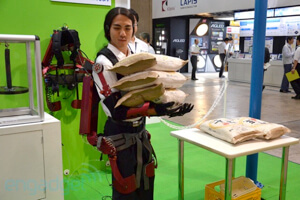 The University of Tokyo’s latest robot suit can help humans lift heavy loads using naught but air. How exactly? Instead of complex, heavy electronic actuators, the suit uses simpler pneumatic artificial musc...
Butterfly-wing wafers to clad iridescent buildings
New Scientist - 16 Oct 2012 17:12
This might look like a pretty lily pad but it is actually a wafer created with lasers to mimic the iridescent colours of a butterfly's wings
Patent could shackle 3D printers with DRM
New Scientist - 16 Oct 2012 16:29
The ability to make anything you like in a 3D printer could be constrained by a method for checking whether you're using protected intellectual property
Take that, Tatooine: First planet with four suns found
New Scientist - 16 Oct 2012 16:17
PH1 orbits a pair of stars that are in turn orbited by a binary system, giving the exoplanet two more suns than Tatooine in Star Wars
Eye-contact detector found in the brain
New Scientist - 16 Oct 2012 16:17
A study in macaques has identified a set of neurons that fire only when the monkey makes eye contact with another macaque
Experience supersonic free fall in complete safety
New Scientist - 16 Oct 2012 15:32
We hope you've fully digested your lunch. Here is the latest video Red Bull has released of Felix Baumgartner's supersonic free fall on Sunday
When sculpting with data, does vagueness make art?
New Scientist - 16 Oct 2012 12:56
A new exhibition explores the overlap between information visualisation and art – but the results are sometimes frustratingly vague
The five most promising new cancer treatments
New Scientist - 16 Oct 2012 09:00
A host of experimental therapies are emerging that could dramatically improve our chances of curing cancer, say Shaoni Bhattacharya and Clare Wilson (full text available to subscribers)
Newswire: CNRS/CEA - New type of cosmic ray discovered after 100 years
Interactions - 16 Oct 2012 07:00
Using the European X-ray astronomy satellite XMM-Newton(1), researchers from CNRS(2) and CEA (3) have discovered a new source of cosmic rays. In the vicinity of the remarkable Arches cluster, near the center of the Milky...
Ada Lovelace: My brain is more than merely mortal
New Scientist - 16 Oct 2012 01:01
The author of the first computer program talks, via her letters, about her colleague Charles Babbage, the Analytical Engine and what the future holds
 Global
 Great Britain
 Indian
 South Africa