Science News
 American
Science News for 4 April 2014
American
Science News for 4 April 2014
Lassa Fever Reported in US Traveler Returning from West Africa
Live Science - 4 Apr 2014 23:46 A Minnesotan returning home from West Africa has tested positive for Lassa fever, health officials have confirmed.
Earthquake Strikes Near Greece
Live Science - 4 Apr 2014 23:24
An earthquake of preliminary magnitude 5.7 shook Greece today (April 4), according to the U.S. Geological Survey (USGS).
The Week In Drones: Rescuing A Puppy, Crashing In South Korea, And More
Popular Science - 4 Apr 2014 22:06
A Beagle Puppy Looks like this pup won't need a drone to escape his predicament. Diablito63 via Wikimedia Commons Here's a roundup of the week's top drone news, designed to capture the military, commercial, non-profit, a...
'Meteorite' Misses Skydiver During Jump, Fireball In 'Dark Flight' Captured On Camera [VIDEO]
IBTimes - 4 Apr 2014 21:34
A Norwegian skydiver claims he has proof that he almost collided with a meteorite. Video captured in 2012 of Anders Helstrup and several other members of Oslo Parachute Club was shared on YouTube on Thursday, showing wha...
Images of Rescued Seals and Sea Lions
Live Science - 4 Apr 2014 20:32 The Marine Mammal Center in Sausalito, Calif., runs a clinic that rescues sick, injured and orphaned seals, sea lions and other marine mammals.
Baby Volcanic Island Eats Its Older Neighbor
Live Science - 4 Apr 2014 20:30 As a seafloor volcano continues to erupt in a remote part of the Pacific Ocean, a newborn island has swallowed its neighbor whole, images from space show.
Hawaiian Monk Seal Hospital Aims to Save Endangered Species
Live Science - 4 Apr 2014 19:34 A new hospital for sick or injured Hawaiian monk seals is nearing completion, and will open to its doors to seagoing patients this summer.
Iowa State scientist developing materials, electronics that dissolve when triggered
e! Science News - 4 Apr 2014 19:11
A medical device, once its job is done, could harmlessly melt away inside a person's body. Or, a military device could collect and send its data and then dissolve away, leaving no trace of an intelligence mission. Or, an...
Today on New Scientist
New Scientist - 4 Apr 2014 18:30
All the latest on newscientist.com: lost human species, doctor woven into your clothes, Lake Superior on Saturnian moon, China's ancient coal use and more
5 Things Dark Matter Could Be - The Countdown #45
Scientific American - 4 Apr 2014 18:01
Twenty-seven percent of the Universe is made of invisible dark matter. But what is it? In this episode, we cover the top five candidates that may fit the bill. Host/writer: Sophie... --
Beer on Twitter: Finding Drinking Patterns in Tweet Data (Infographic)
Live Science - 4 Apr 2014 17:25 Researchers create maps of beer preferences by geotagging tweets.
Cheap Mobile Eye Exams For Rural Poor Made Possible With Smartphones
Singularity Hub - 4 Apr 2014 17:00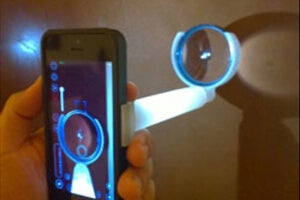 The World Health Organization estimates some 90% of the world's visually impaired folks live in the developing world. Most suffer from correctible but undiagnosed refractive errors like cataracts. Opthalmic equipment is ...
Scientists probe the next generation of 2-D materials
Phys.org - 4 Apr 2014 02:00
As the properties and applications of graphene continue to be explored in laboratories all over the world, a growing number of researchers are looking beyond the one-atom-thick layer of carbon for alternative materials t...
Best dark matter signal yet hints at heftier particles
New Scientist - 4 Apr 2014 20:23
Gamma rays from the Milky Way's middle are increasingly likely to be signs of dark matter, and hints of the same signal from dwarf galaxies boost the case
Push-button orgasm isn't worth $6 million to medicine
New Scientist - 4 Apr 2014 19:16
The doctor who discovered that a spinal implant meant for pain relief can also trigger orgasms says that we are unlikely to see an orgasmatron any time soon
NASA's Russia boycott may revitalise US space leadership
New Scientist - 4 Apr 2014 19:03
Cooling NASA-Russia ties is a familiar political game, but it may spark talk on reasserting US leadership in space, says security expert Joan Johnson-Freese
Simple Invention For Sealing Gunshot Wounds Gets FDA Approval
Popular Science - 4 Apr 2014 18:48
XStat Photograph by Ralph Smith The pocket-sized XStat, a hemorrhage-stopping invention we wrote about in February, yesterday received approval from the U.S. Food and Drug Administration as a first-of-its-kind medical dr...
Smoky mass map weighs fat ancient galaxy cluster
New Scientist - 4 Apr 2014 18:11
It's not something in your eye. It's not smoke from a late-night barbecue. You're looking at a map of the most massive ancient galaxy cluster ever seen
Zoologger: The blind fish that sucks it and 'sees'
New Scientist - 4 Apr 2014 17:49
For a creature with no eyes, the Mexican blind cavefish is surprisingly nimble, thanks to a unique navigation system based on the ability to suck
Why Cereal-Box Mascots Stare at You in the Supermarket
Live Science - 4 Apr 2014 17:28 Yes, kids, Cap'n Crunch is looking at you. The mascots on boxes of cereal advertised to children tend to stare downward to catch the gaze of kids. Why? Eye contact helps increase feelings of trust in a brand, a new study...
New Atomic Clock Is Most Accurate Timekeeper Yet
Live Science - 4 Apr 2014 16:22 A new atomic clock unveiled today (April 3) is three times more precise than the one previously used to keep official time in the United States, making it the most accurate timekeeper yet developed.
The Quantified Self: How Data-Obsessed Trackers Push Toward Healthier Lives
Live Science - 4 Apr 2014 16:20 Members of the quantified self movement use technology to collect data about themselves, for self-insight and self-improvement. As tools to track our lives become more ubiquitous, experts say they could help the general ...
 Global
 Great Britain
 Indian
 South Africa