Science News
 American
Science News for 16 December 2014
American
Science News for 16 December 2014
Strange Rock from Russia Contains 30,000 Diamonds
Live Science - 16 Dec 2014 22:05 The most diamond-rich rock ever found was discovered in Russia's Udachnaya diamond mine.
Medieval City's Underground Ruins Discovered in England
Live Science - 16 Dec 2014 14:00 A team of archaeologists uncovered the layout of a medieval city in southern England using high-tech survey equipment.
Born to dance: The animals with natural rhythm
New Scientist - 16 Dec 2014 22:00
Dogs and ducks are duds on the dance floor. So how come cockatoos and sea lions can move to a beat, and what does that tell us about our own musicality? (full text available to subscribers)
Lead islands in a sea of graphene magnetize the material of the future
e! Science News - 16 Dec 2014 00:11
Researchers in Spain have discovered that if lead atoms are intercalated on a graphene sheet, a powerful magnetic field is generated by the interaction of the electrons' spin with their orbital movement. This property co...
Machine assistants learn to run your schedule
New Scientist - 16 Dec 2014 23:00
Got a busy calendar? Let AI assistants set your meetings for you and suggest friends for you to interact with
Asteroid soil could fertilise farms in space
New Scientist - 16 Dec 2014 22:30
We can now grow plants in microgravity - and crops grown in asteroid soil could sustain vast human populations off-planet
An Offer You Can't Refuse: How Extortion Can Enhance Cooperation in Society
Physics Buzz - 16 Dec 2014 22:00
Cooperation is a hard behavior to explain. Often it involves making at least a small sacrifice for the benefit of the whole, which superficially seems to be at odds with evolutionary pressures that encourage individuals ...
Table-top 'mini-LHC' ramps up to record energy
New Scientist - 16 Dec 2014 21:30
A laser-driven particle accelerator just 9 centimetres long is gearing up to rival heavyweights like the Large Hadron Collider
Is sexology just too human to study?
New Scientist - 16 Dec 2014 21:00
Can we hope to study something as human as sex in any scientific way? A new exhibition and two books leave plenty of room for doubt
Planetary science: Curiouser and curiouser
The Economist - 16 Dec 2014 20:30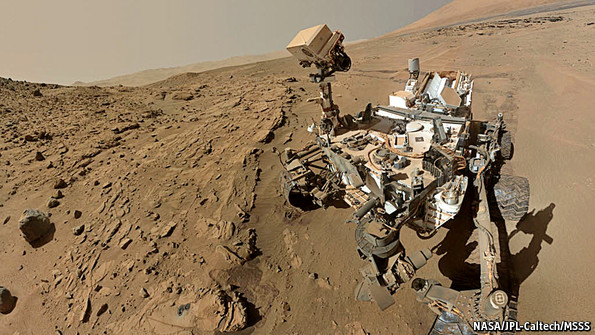 EARTH aside, Mars is the most-studied planet in the solar system. Over the past half century a fleet of probes has photographed it, prodded it, sniffed it and blasted it with lasers. Most of the data those probes have ga...
'This is our policy': New Scientist after 3000 issues
New Scientist - 16 Dec 2014 20:00
A lot has changed in science, and science journalism, over the past 58 years - but our responsibilities remain the same
Physics professor publishes exact solution to model Big Bang and quark gluon plasma
Phys.org - 16 Dec 2014 19:51 Unlike in mathematics, it is rare to have exact solutions to physics problems.
Deadly Cholera Outbreaks Could Increase with Climate Change
Live Science - 16 Dec 2014 19:50 Regions of the world that experience extreme weather shifts due to climate change may become more vulnerable to the spread of cholera, scientists report.
Greenland's Ice-Melt Models May Be Too Sunny
Live Science - 16 Dec 2014 19:17 The vast ice sheet covering Greenland could melt more quickly in the future than existing models predict, new research suggests.
Earthquake Pre-cursors? 'Slow Slip' Monitoring May Figure Risks | Video
Live Science - 16 Dec 2014 19:14 Conventional Earthquake measurement equipment is not sensitive enough to quantify the slow moving "slip" of a fault in the Earth. Researchers are now using GPS tools to measure movement, which may help assess risks of de...
Mobile, the Metatrend of the Decade
Singularity Hub - 16 Dec 2014 18:00 Four billion people are buying new smartphones every two years, massively outpacing the PC industry (where we buy 1.6 billion PCs every five years). Our desire for the most powerful,...
Microwave imaging system promises better, cheaper breast images for cancer screening
Phys.org - 16 Dec 2014 18:00 Although currently available diagnostic screening systems for breast cancer like X-ray computed tomography (CT) and mammography are effective at detecting early signs of tumors, they are far from perfect, subjecting pati...
Red hot lava battles snow as Russian volcano erupts
New Scientist - 16 Dec 2014 18:00
Volcano observations reveal jets of steam shooting out of the ice and lava moving like a giant caterpillar - although the lava type can make a big difference
How to think about... Relativity
New Scientist - 16 Dec 2014 18:00
It's been called the greatest theory ever devised - we explain it using two spaceships, two clocks and a black hole (full text available to subscribers)
NIST physicists build a watt balance using LEGO blocks to measure Planck's constant
Phys.org - 16 Dec 2014 17:20 (Phys.org)--A team of physicists at the National Institute of Standards and Technology (NIST) outside of Washington D.C. has found a way to bring physics to the masses--they've designed and built a watt balance based on ...
Keep snuggly warm with self-heating nanowire clothes
New Scientist - 16 Dec 2014 17:11
Fabric laced with silver nanowires traps heat and could even be warmed up like an electric blanket
Zoologger: Baby lobster with a taste for jellyfish surfing
New Scientist - 16 Dec 2014 17:10
Smooth fan lobster larvae hop aboard passing jellyfish for a free ride and a gourmet meal. But to survive the trip they need a strict beauty regime
 Global
 Great Britain
 Indian
 South Africa