Science News
 American
Science News for 2 November 2015
American
Science News for 2 November 2015
EU funds design study for European plasma accelerator
Phys.org - 2 Nov 2015 16:23 The European Union supports the development of a novel plasma particle accelerator with three million euros from the Horizon2020 program. The EU project EuPRAXIA (European Plasma Research Accelerator with eXcellence In A...
ITER diagnostics heat up across the US
Phys.org - 2 Nov 2015 17:46 ITER, the world's largest tokamak now under construction in France, will have over 60 diagnostic systems installed to enable plasma control, optimize plasma performance, and support machine protection. Princeton Plasma P...
Early contact with dogs linked to lower risk of asthma
Science Daily - 2 Nov 2015 21:36 Scientists have used national register information in more than one million children to study the association of early life contact with dogs and subsequent development of asthma. This question has been studied extensive...
MicroBooNE sees first accelerator-born neutrinos
Symmetry Magazine - 2 Nov 2015 16:00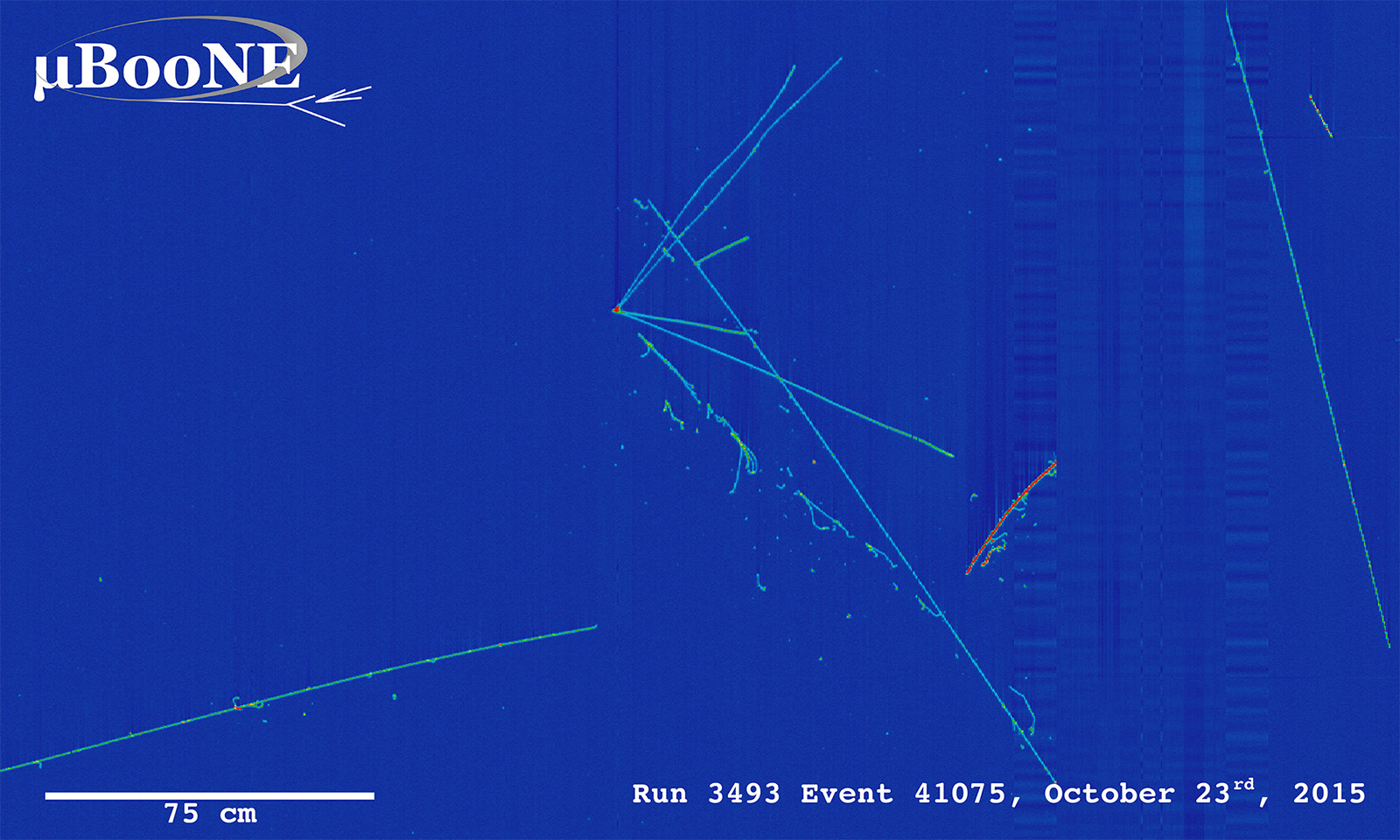 The results of the MicroBooNE experiment will be relevant for the forthcoming Deep Underground Neutrino Experiment. Today the MicroBooNE collaboration announced that it has seen its first neutrinos in the experiment's ne...
Sleepwalkers feel no pain, remain asleep despite suffering injuries
Science Daily - 2 Nov 2015 17:02 A new study of sleepwalkers found an intriguing paradox: Although sleepwalkers have an increased risk for headaches and migraines while awake, during sleepwalking episodes they are unlikely to feel pain even while suffer...
Physiology Pioneer's Nobel Prize Sells for Nearly $800,000
Live Science - 2 Nov 2015 16:01 One scientist's hard-earned golden prize just sold for a sizeable chunk of change.
Into how many pieces does a balloon burst?
Phys.org - 2 Nov 2015 15:48 A moderately inflated rubber balloon pricked with a needle bursts into two large fragments. However, if you inflate it until it bursts spontaneously, you get dozens of shreds.
Tissue cartography
EurekAlert! - 2 Nov 2015 07:00
(University of California - Santa Barbara) Today's state-of-the-art optical microscopes produce voluminous three-dimensional data sets that are difficult to analyze. Now, two postdoctoral scholars from UC Santa Barbara's...
Restaurants listing calorie counts on the menu offer more lower-calorie items
Science Daily - 2 Nov 2015 23:43
Large U.S.-based chain restaurants that voluntarily list calorie counts on their menus average nearly 140 fewer calories per item than those that do not post the information, new research suggests.
Researchers give peptides a longer life
Science Daily - 2 Nov 2015 23:41
A biochemical trick has been developed that can significantly extend the lifespan of peptides, smaller cousins of proteins. The finding opens up new possibilities for creating peptides to treat cancer, infertility and ot...
Research team broadens utility of more compact CRISPR-Cas9 by increasing its targeting range
Science Daily - 2 Nov 2015 23:40
Investigators have shown that a method they developed to improve the usefulness and precision of the most common form of the gene-editing tools CRISPR-Cas9 RNA-guided nucleases can be applied to Cas9 enzymes from other b...
Obese people need more vitamin E, but actually get less
Science Daily - 2 Nov 2015 23:37
Obese people with metabolic syndrome face an unexpected quandary when it comes to vitamin E -- they need more than normal levels of the vitamin because their weight and other problems are causing increased oxidative stre...
Death rates, health problems, rise among middle-aged white Americans
Science Daily - 2 Nov 2015 23:37 Researchers found that middle-aged white Americans had higher rates of mortality and morbidity between 1999-2013 than other ethnic groups. Leading causes of death were suicide, alcohol and drug poisoning, and liver disea...
How a Family Dog May Lower a Child's Asthma Risk
Live Science - 2 Nov 2015 22:55 Kids who live in a house with a dog before they turn 1 have a lower risk of asthma a few years later, a new study suggests.
Micro Mollusk Breaks Record for World's Tiniest Snail
Live Science - 2 Nov 2015 22:47 An itsy-bitsy mollusk in Borneo is the new record holder for the world's smallest known snail, a new study finds.
Researchers reduce inflammation in human cells, a major cause of frailty
Science Daily - 2 Nov 2015 22:37
Chronic inflammation, closely associated with frailty and age-related diseases, is a hallmark of aging. Now researchers have discovered that inhibiting key enzyme pathways reduces inflammation in human cells in culture d...
Predicting cancer's growth from few clues
Science Daily - 2 Nov 2015 22:28
Duke mathematicians are developing ways to help doctors predict how different cancers are likely to progress when measurements of tumor growth are hard to come by. In a new study, they describe a way to compare common mo...
Research elucidates genetics behind Salmonella's host specificity
Science Daily - 2 Nov 2015 22:28 Using genomic techniques, slight variations in the coding sequence of proteins that bind Salmonella to host cells can determine what type of animal a particular strain infects, new research indicates.
'Inner GPS' study may aid diagnosis of brain diseases
Science Daily - 2 Nov 2015 22:28
A new study sheds light on brain cells in our 'inner GPS,' which may improve understanding of memory loss and wandering behavior in people with Alzheimer's and other neurodegenerative diseases.
Structure of tuberculosis enzyme revealed, could offer drug target
Science Daily - 2 Nov 2015 22:27 A team of scientists has determined the structures of several important tuberculosis enzymes, which could lead to new drugs for the disease.
How new hydrogel can facilitate microsurgery
Science Daily - 2 Nov 2015 22:27
Skillful surgeons can do amazing things in extremely small places, but finding better ways to suture tiny blood vessels has been an ongoing challenge for even the best. In a new article, several researchers show how a ne...
Cancer cells use secret tunnels to communicate, smuggle cancer signals their neighbors
Science Daily - 2 Nov 2015 22:27
Cancer cells use previously unknown channels to communicate with one another and with adjacent non-cancerous cells, a new report suggests. The researchers report that an in vitro co-culture system robustly quantifies the...
 Global
 Great Britain
 Indian
 South Africa