Science News
 American
Science News for 4 November 2015
American
Science News for 4 November 2015
Cyclone Chapala may bring three years of rain in a day to Yemen
New Scientist - 4 Nov 2015 20:00
The Al-Qaida-held city of Mukalla has been battered by the cyclone since it made landfall in a country currently in the midst of civil war
Matthew 22:39
The Economist - 4 Nov 2015 23:33 AN ARGUMENT often advanced for the encouragement of religion is that, to paraphrase St Matthew's report of Jesus's words, it leads people to love their neighbours as themselves. That would be a powerful point were it tru...
Research evaluates racial differences in GI cancer biology
Science Daily - 4 Nov 2015 22:27 Because Americans of African descent are at a higher risk for developing GI cancers than others, a group of researchers is teaming up to launch a program to assess GI cancer biology in patients.
Chinese Robot Just Kept Walking...and Walking...and Walking
Live Science - 4 Nov 2015 22:19 A four-legged robot with serious athletic endurance recently walked its way right into the history books.
Some 3-D printed objects are toxic
Science Daily - 4 Nov 2015 22:15 Parts produced by some commercial 3-D printers are toxic to certain fish embryos, new research shows. These results have raised questions about how to dispose of parts and waste materials from 3-D printers.
Sound waves levitate cells to detect stiffness changes that could signal disease
Science Daily - 4 Nov 2015 22:10 Physicists are literally applying rocket science to the field of medical diagnostics. With a few key changes, the researchers used a noninvasive ultrasonic technique originally developed to detect microscopic flaws in so...
Connections discovered between masculinity, energy drink use, and sleep problems
Science Daily - 4 Nov 2015 22:09
Energy drinks have grown in popularity for many Americans, but there is growing concern about the health risks of consuming them in large quantities. Because men are the main consumers of energy drinks, a research team s...
Sound waves levitate cells to detect stiffness changes that could signal disease
Phys.org - 4 Nov 2015 21:00 Utah Valley University physicists are literally applying rocket science to the field of medical diagnostics. With a few key changes, the researchers used a noninvasive ultrasonic technique originally developed to detect ...
Insulin sensitivity: One night of poor sleep could equal six months on a high-fat diet, study in dogs suggests
Science Daily - 4 Nov 2015 20:40 New research finds that one night of sleep deprivation and six months on a high-fat diet could both impair insulin sensitivity to a similar degree, demonstrating the importance of a good night's sleep on health. This stu...
CK5 marks cisplatin-resistant ovarian cancer
Science Daily - 4 Nov 2015 20:32
Protein cytokeratin 5 (CK5), known to be a marker of poor prognosis in breast cancer, also marks ovarian cancers likely to be resistant to the common chemotherapy cisplatin, new research confirms.
Researchers discover size gene for salmon
Science Daily - 4 Nov 2015 20:32 The size of returning Atlantic salmon is largely dependent on the number of years that the salmon remains at sea before returning to spawn in the river. The genetic basis of this trait has not been previously known, maki...
Designing ice repellent materials
Phys.org - 4 Nov 2015 20:27 Materials that actively repel water and ice very strongly are sought after by the aviation industry and for many other technical applications. ETH researchers have now found out how to specifically design the rigid surfa...
No one should die alone: The gift of being there for patients
Science Daily - 4 Nov 2015 20:14 The Not Alone Transition Companion program has been launched in an American hospital to provide critically ill or dying patients with a companion when family members or friends are not available.
Physicists measure force that makes antimatter stick together
Phys.org - 4 Nov 2015 20:00 Peering at the debris from particle collisions that recreate the conditions of the very early universe, scientists have for the first time measured the force of interaction between pairs of antiprotons. Like the force th...
My pretty maid
The Economist - 4 Nov 2015 20:00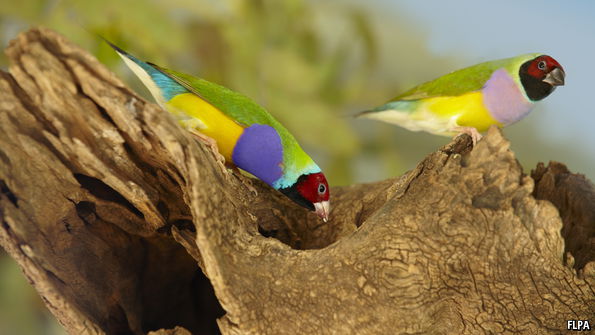 Nice outfit, dear HOW the peacock got his tail is one of natural history's "Just So" stories that biologists like to think they have cracked. His tail is for showing off to the ladies just how fit he and his genes are. A...
Mars is ripping its beanbag moon Phobos apart
New Scientist - 4 Nov 2015 20:00
The Red Planet's gravity is slowly shredding its largest moon, which is already a rubble pile with a thin shell of dust
Losing sense of smell could be linked to poor health
New Scientist - 4 Nov 2015 20:00
Lacking an immune system means it's a struggle to recognise certain smells - if you're a mouse. And it could be to stop you sniffing out danger
Australia can go green and have economic growth - if it wants to
New Scientist - 4 Nov 2015 20:00
Coal-free, low-emission, high growth. That could be the future of the currently resource-dependent Australia, as long as politicians take action
Leading theory of consciousness rocked by oddball study
New Scientist - 4 Nov 2015 20:00
Scientist show that widespread activity occurs in the brain even during unconscious processing - which shouldn't happen if our theories of consciousness are correct
Vitamin supplements could save critically endangered kakapo
New Scientist - 4 Nov 2015 20:00
The fate of the world's heaviest parrot depends on a berry from an unreliable tree. Now conservationists have finally come up a replacement
Confusion reigns over mid-air break up of Russian flight 7K9268
New Scientist - 4 Nov 2015 20:00
Flight recorder of the plane that crashed in Egypt killing 224 people has yet to be analysed, but a tracking website may have captured its last moments
Lie-detecting algorithm spots fibbing faces better than humans
New Scientist - 4 Nov 2015 20:00
Move over Columbo. By studying courtroom videos, a computer has learned to detect the facial expressions of liars so well it can beat the best interrogators
 Global
 Great Britain
 Indian
 South Africa