Science News
 American
Science News for 21 September 2016
American
Science News for 21 September 2016
Common genetic variant regulates the mental health benefits of exercise
Science Daily - 21 Sep 2016 16:39
A new study revealed that a common genetic variant in the brain-derived neurotrophic factor gene reduces the neurobiological benefits induced by physical exercise in mice.
A non-probabilistic quantum theory produces unpredictable results
Phys.org - 21 Sep 2016 16:30 (Phys.org)--Quantum measurements are often inherently unpredictable, yet the usual way in which quantum theory accounts for unpredictability has long been viewed as somewhat unsatisfactory. In a new study, University of ...
DARPA's 'Aerial Dragnet' Will Monitor Drones in Cities
Live Science - 21 Sep 2016 14:04 A drone to watch the other drones?
Biological 'dark matter' molecule plays surprise role in heart failure
Science Daily - 21 Sep 2016 23:19
A molecule that appears to play a key role in the development of heart failure has been discovered by researchers. The scientists found that blocking the molecule, known as chaer, in animal studies prevented the animals ...
How can we make tomorrow's doctors healthier now?
Science Daily - 21 Sep 2016 23:09
A randomized study aims to learn whether wearing activity trackers and incorporating physical activity education helps student-physicians improve their activity levels. Researchers say they're motivated by studies sugges...
Drug may prevent, reduce progression of MS in mice
Science Daily - 21 Sep 2016 23:09
The experimental drug laquinimod may prevent the development or reduce the progression of multiple sclerosis (MS) in mice, according to new research.
Shaping sound waves in 3D: Tech and medical applications
Science Daily - 21 Sep 2016 22:41 Sound can now be structured in three dimensions. Researchers have found a way of generating acoustic holograms, which could improve ultrasound diagnostics and material testing. The holograms can also be used to move and ...
Computers learn to spot deadly bacteria
Science Daily - 21 Sep 2016 22:33
Machine learning can predict strains of bacteria likely to cause food poisoning outbreaks, research has found. The study -- which focused on harmful strains of E. coli bacteria -- could help public health officials to ta...
Unexpected cause of mutation in cancer identified
Science Daily - 21 Sep 2016 22:26
Researchers looking for a missing cause of a common type of mutation in breast cancer cells have uncovered the biochemical culprit and found that it may also be a general source of mutation in other cancer types.
Importance of breast milk gene for toddler gut bacteria
Science Daily - 21 Sep 2016 22:13
A genetic variation affecting the composition of a mother's breast milk could have a lasting impact on the gut health of her child. Researchers report that children aged two to three had lower levels of 'good' intestinal...
Delaying motor neuron loss
Science Daily - 21 Sep 2016 22:12
A potential treatment to delay motor neuron loss and symptoms has been discovered in the inevitably fatal motor neuron disease (MND). Researchers have reported that triheptanoin, a synthetic triglyceride oil, might help ...
New strategy identified for treating acute myeloid leukemia
Science Daily - 21 Sep 2016 21:58
A promising new approach to the treatment of acute myeloid leukemia (AML) has been discovered by a team of researchers. In their report, the investigators have identified a crucial dysfunction in blood cell development t...
Neutrophils are key to harnessing anti-tumor immune response from radiation therapy, study finds
Science Daily - 21 Sep 2016 21:56
Combining targeted radiation therapy with a neutrophil stimulant enhances anti-tumor immunity, according to new research into cancer immunology.
Trial helps doctors tell Lewy body dementia from Alzheimer's, Parkinson's
Science Daily - 21 Sep 2016 21:19
Knowing that many clinicians find it difficult to correctly diagnose patients with Lewy body dementia, researchers set out to develop a clinical profile for these patients.
Burnt offering
The Economist - 21 Sep 2016 21:18 Read all about it IN 1970 archaeologists digging at Ein Gedi, an ancient settlement on the shores of what is now called the Dead Sea, dug up the ark of a synagogue that had stood on the site from about 800BC until it was...
Incentive malus
The Economist - 21 Sep 2016 21:16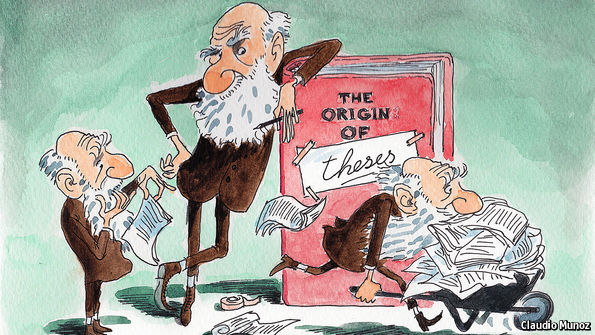 IN 1962 Jacob Cohen, a psychologist at New York University, reported an alarming finding. He had analysed 70 articles published in the Journal of Abnormal and Social Psychology and calculated their statistical "power" (a...
You can't blame your genes if you don't lose weight, study finds
Science Daily - 21 Sep 2016 21:07 You might be able to blame your genes for weighing more and increasing your risk of obesity, but you can no longer blame your genes for failing to lose weight, a comprehensive study has found.
Study questions benefits of testosterone replacement for low T
Science Daily - 21 Sep 2016 20:53
The prescription of testosterone supplementation for cardiovascular health, sexual function, physical function, mood, or cognitive function in men with "low T" is not supported by clinical trials data, conclude researche...
Bile acid uptake inhibitor prevents nash/fatty liver in mice
Science Daily - 21 Sep 2016 20:53
Drugs that interfere with bile acid recycling can prevent several aspects of NASH (nonalcoholic steatohepatitis) in mice fed a high-fat diet, scientists have shown. The findings suggest that these drugs, known as ASBT in...
New immunotherapy for leukemia shows promise in small clinical trial
Science Daily - 21 Sep 2016 20:53 'Training' immune cells boosts effectiveness in patients with acute myeloid leukemia (AML), report scientists. A small clinical trial provides evidence that the immune system's "natural killer" cells can be dialed up in ...
The microdoctors in our bodies
Science Daily - 21 Sep 2016 20:30 Researchers are developing tiny, sophisticated technological and biological machines enabling non-invasive, selective therapies. Their creations include genetically modified cells that can be activated via brain waves, a...
Brain to robot: 'Move, please'
Science Daily - 21 Sep 2016 20:22
Using the power of thought to control a robot that helps to move a paralysed hand: new research could fundamentally change the therapy and daily lives of stroke patients.
 Global
 Great Britain
 Indian
 South Africa