Science News
 American
Science News for 2 November 2016
American
Science News for 2 November 2016
Engineering students creating scoliosis brace that focuses on comfort, fit, design
Science Daily - 2 Nov 2016 21:52
Mechanical engineering students are collaborating with a local doctor and a private company to create a brace that, well, fits like a glove--and is just as comfortable.
MAGNDATA: Towards a database of magnetic structures
EurekAlert! - 2 Nov 2016 06:00
(International Union of Crystallography) The quantitative characterisation of the magnetic ordering realised in magnetic phases is an essential part of research into the magnetic properties of solids. It is certainly fun...
What Do We Really Know About Our Universe?
Physics Buzz - 2 Nov 2016 23:38
In October alone, scientists published papers in reputable journals questioning what we think we know about the expansion of the universe, galaxy formation, the number of galaxies in the universe, and the number of plane...
Depths of imagination
The Economist - 2 Nov 2016 23:03
WIND farms and solar-energy plants have the advantage that their fuel is free, but the disadvantage that the availability of that fuel may change from minute to minute. If they are to become the large-scale contributors ...
Tested, and found wanting
The Economist - 2 Nov 2016 23:03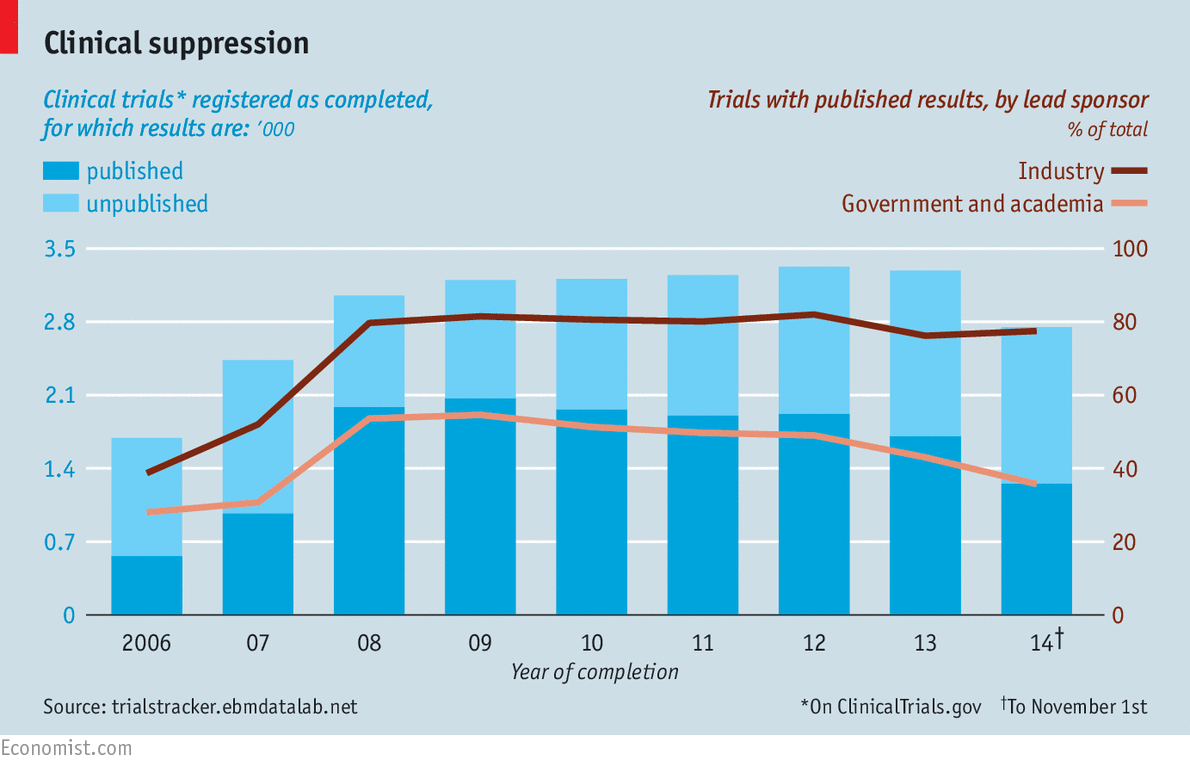 HALF of clinical trials do not have their results published. Those behind the TrialsTracker, a web tool created by the Evidence-Based Medicine Data Lab, at Oxford University, hope to change this. Using clinicaltrials.gov...
Having no truck with it
The Economist - 2 Nov 2016 23:03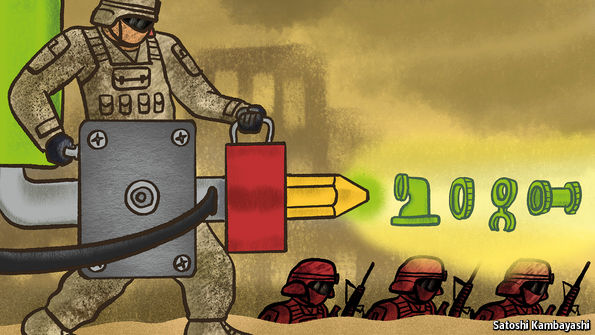 "AMATEURS talk strategy, but professionals talk logistics." That military maxim's latest consequence is the adoption by the world's armed forces of three-dimensional (3D) printing on the front line. It will be a while be...
The watchers on the Web
The Economist - 2 Nov 2016 23:03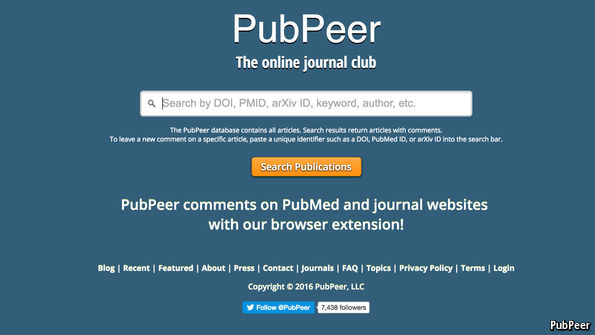 MANY scientific studies are flawed. Often, the reason is poor methodology. Sometimes, it is outright fraud. The conventional means of correction--a letter to the journal concerned--can take months. But there is now an al...
The pop-up effect: Why buoyant spheres don't always leap out of the water
Phys.org - 2 Nov 2016 22:32 It's a common swimming pool game: Force a buoyant ball underwater and let it go. The ball springs to the surface and jumps into the air. But, submerge the ball deeper underwater and the effect is often disappointing. Con...
Fluorescent sensor provides low-cost diagnosis of cystic fibrosis
Science Daily - 2 Nov 2016 21:52 Scientists have developed a new diagnostic test for cystic fibrosis. The new device provides a cheaper, easier way to detect levels of chloride in sweat, which are elevated in cystic fibrosis patients.
Link between early menopause, higher risk of fracture, new study confirms
Science Daily - 2 Nov 2016 21:52
Fracture risk for those with early menopause is not minimized by use of calcium, vitamin D, or standard dose hormone therapy, data pulled from clinical trials shows.
#AskSymmetry Twitter chat with Leonardo Senatore
Symmetry Magazine - 2 Nov 2016 21:04
See theorist Leonardo Senatore's answers to readers' questions about parallel universes.
First time physicists observed, quantified tiny nanoparticle crossing lipid membrane
Science Daily - 2 Nov 2016 20:43 A new discovery may raise concerns about safety of nanomaterials for public health and may suggest to revise the security norms at nanoscale bringing attention to the safety of nanomaterials in general.
Engineers develop new magnetic ink to print self-healing devices that heal in record time
Science Daily - 2 Nov 2016 20:35 A magnetic ink has been developed that can be used to make self-healing batteries, electrochemical sensors and wearable, textile-based electrical circuits.
Bioelectronics at the speed of life
Science Daily - 2 Nov 2016 20:21 With a microfabricated ion pump built from organic electronic components, ions can be sent to nerve or muscle cells at the speed of the nervous system and with a precision of a single cell, say scientists.
Genetic analysis identifies proteins controlling sleep in mice
Science Daily - 2 Nov 2016 20:21
A genetic screening approach has been used to identify mutations that affect sleep/wakefulness in mice, international researchers report. The amount of rapid eye movement (REM) sleep and non-REM sleep shown to be regulat...
Professor developing super-resolution microscopy techniques
Phys.org - 2 Nov 2016 20:20 For scientists developing life-saving medicines, knowing how cells interact and communicate with one another is an important part of the puzzle. The problem is, being able to see those interactions through a microscope h...
Is It Morally Justifiable to Kill an Endangered Animal if a Human Life Is at Risk?
KQED Quest - 2 Nov 2016 20:13 This post is part of KQED’s Do Now U project. Do Now U is a biweekly activity for students and the public to engage and respond to current issues using social media. Do Now U aims to build civic engagement and digital ...
French particle accelerator to embark on 'exotic' quest
Phys.org - 2 Nov 2016 20:06 Long thought to be the smallest building blocks of all matter, we now know atoms are themselves composed of electrons spinning around a nucleus made of protons and neutrons.
Drug that stops brain plaques may show if they cause Alzheimer's
New Scientist - 2 Nov 2016 20:00
A drug has been shown to switch off plaque production in the brain harmlessly, but trial results due next summer might reveal if this halts disease
Supercomputer comes up with a profile of dark matter: Standard Model extension predicts properties of candidate particle
Phys.org - 2 Nov 2016 20:00 In the search for the mysterious dark matter, physicists have used elaborate computer calculations to come up with an outline of the particles of this unknown form of matter. To do this, the scientists extended the succe...
Classic quantum experiment could conceal theory of everything
New Scientist - 2 Nov 2016 20:00
A tweak to the iconic double-slit experiment could reveal if quantum mechanics is incomplete, and maybe lead to a theory of quantum gravity
A huge problem still lurks at the heart of Paris climate deal
New Scientist - 2 Nov 2016 20:00
As the Paris climate deal becomes legally binding, the world must stop pinning hopes on negative emissions technology, say Kevin Anderson and Glen Peters
 Global
 Great Britain
 Indian
 South Africa