Space News
 American
Space News for 2 August 2014
American
Space News for 2 August 2014
Best evidence yet for coronal heating theory detected by NASA sounding rocket
Phys.org - 2 Aug 2014 00:22 Scientists have recently gathered some of the strongest evidence to date to explain what makes the sun's outer atmosphere so much hotter than its surface. The new observations of the small-scale extremely hot temperature...
Best Space Photos of the Week - Aug. 2, 2014
SPACE.com - 2 Aug 2014 21:28 From weird orbits of alien planets to a gecko-filled space capsule, don't miss these amazing space images of the week for Aug. 2, 2014.
GPS satellite launched into space
Phys.org - 2 Aug 2014 21:18
A new Global Positioning System (GPS) satellite has been launched into space.
A Tortuous Path in Lunar Crater Posidonius
SpaceRef - 2 Aug 2014 19:59
This may look like a work of abstract art, but in reality, it's our Moon and is for science. The Lunar Reconnaissance Orbiter Camera, or LROC, is a system of three cameras mounted on the Lunar Reconnaissance Orbiter (LRO...
Rosetta: 1000 km and Closing
Bad Astronomy - 2 Aug 2014 19:57
Getting closer... This shot was taken by the Rosetta spacecraft on Aug. 1, 2014 when it was just over 1000 km (630 miles) from the comet 67P/Churyumov-Gerasimenko. It has twice the resolution as the picture I posted a fe...
Best Evidence Yet For Coronal Heating Theory Detected by Sounding Rocket
SpaceRef - 2 Aug 2014 19:53
Scientists have recently gathered some of the strongest evidence to date to explain what makes the sun's outer atmosphere so much hotter than its surface....
Rosetta is less than 1,000 Km From Its Target
SpaceRef - 2 Aug 2014 19:49
Rosetta sees the comet just five days before arrival. This image was acquired 1 August at 04:48 CEST (02:48 UTC) by the OSIRIS Narrow Angle Camera on board ESA's Rosetta spacecraft. The distance was approximately 1000 km...
Mystery Molecules of the Interstellar Medium --"Many of the Things Quite Abundant There are Unknown on Earth" (Weekend Feature)
The Daily Galaxy - 2 Aug 2014 18:00
Astronomers have long known that interstellar molecules containing carbon atoms exist and that by their nature they will absorb light shining on them from stars and other luminous bodies. Because of this, a number of sci...
How to See the Brightest Planets in the August Sky
SPACE.com - 2 Aug 2014 15:12 Stargazers looking to the sky in August will have a planetary smorgasbord at their disposal. Mars, Jupiter, Saturn and Venus all get their time to shine this month.
Greetings, Agents of S.H.I.E.L.D.
Bad Astronomy - 2 Aug 2014 13:30
If you're reading this, then the blog software has identified you as an agent of S.H.I.E.L.D., and this blog post has been automatically decrypted for you (FYI, members of the public will see this article being about why...
Physics Week in Review: August 2, 2014
Scientific American - 2 Aug 2014 11:36
Looking for a few good popular math books? In the latest New York Times Book Review, I look at five terrific recent ones: Jordan Ellenberg's How Not to Be Wrong, David J. --
Best evidence yet for coronal heating theory detected by NASA sounding rocket
e! Science News - 2 Aug 2014 10:42
Scientists have recently gathered some of the strongest evidence to date to explain what makes the sun's outer atmosphere so much hotter than its surface. The new observations of the small-scale extremely hot temperature...
Rosetta Closing in on Comet 67P/Churyumov-Gerasimenko after Decade Long Chase
Universe Today - 2 Aug 2014 05:15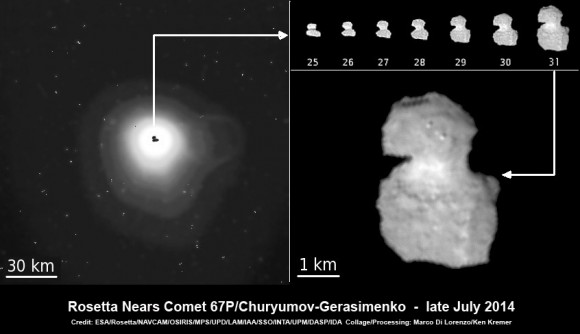 The European Space Agency's (ESA) Rosetta spacecraft is at last rapidly closing in on its target destination, Comet 67P/Churyumov-Gerasimenko, after a decade long chase of 6.4 billion kilometers through interplanetary sp...
NASA Ames Team Conducts Field Campaign Events in Idaho
PTTU - 2 Aug 2014 04:17 NASA's Ames Research Center News and Features: The The Field Investigations to Enable Solar System Science and Exploration (FINESSE) team's first field campaign from July 29 to August 8, 2014 will include a media opportu...
 Global
 Great Britain
 Indian
 South Africa