Space News
 American
Space News for 19 May 2016
American
Space News for 19 May 2016
Hubble takes Mars portrait near close approach
e! Science News - 19 May 2016 22:22
Bright, frosty polar caps, and clouds above a vivid, rust-colored landscape reveal Mars as a dynamic seasonal planet in this NASA Hubble Space Telescope view taken on May 12, 2016, when Mars was 50 million miles from Ear...
New Horizons Sends Back First Science On Distant Kuiper Belt Object
Universe Today - 19 May 2016 21:31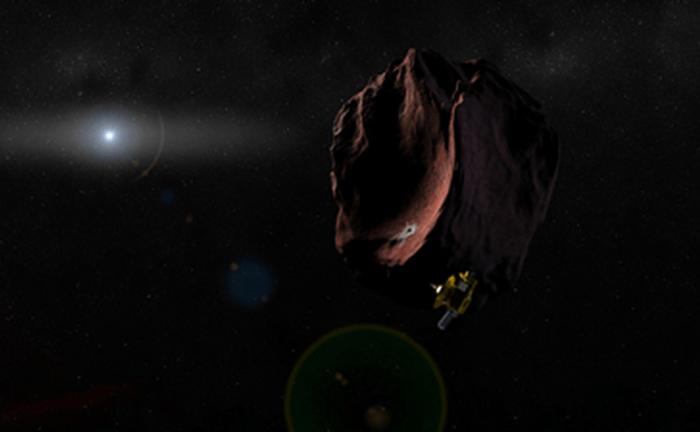 Even the most curmudgeonly anti-space troll has to admit that the New Horizons mission to Pluto has been an overwhelming success. It's not like New Horizons discovered life or anything, but it did bring an otherwise cold...
NASA mini-balloon mission maps migratory magnetic boundary
Phys.org - 19 May 2016 20:46 During the Antarctic summer of 2013-2014, a team of researchers released a series of translucent scientific balloons, one by one. The miniature membranous balloons - part of the Balloon Array for Radiation-belt Relativis...
Giant Tsunamis Washed over Ancient Mars
Scientific American - 19 May 2016 19:45 Meteorite impacts triggered enormous waves in now-vanished ocean --
Hubble takes Mars portrait near close approach
Phys.org - 19 May 2016 19:44 During May 2016 the Earth and Mars get closer to each other than at any time in the last ten years. The NASA/ESA Hubble Space Telescope has exploited this special configuration to catch a new image of our red neighbour, ...
Photo Release: Close-up of the Red Planet
PTTU - 19 May 2016 19:00 Hubble Space Telescope News:
Advanced Alien Life? SETI Retargets "Pale Red Dots Billions of Years Older Than Our Sun" (Thursday's Most Popular)
The Daily Galaxy - 19 May 2016 18:54
The SETI Institute belives that planetary systems orbiting red dwarfs -- dim, long-lived stars that are on average billions of years older than our sun -- are worth investigating for signs of advanced extraterrestrial li...
Canada Wildfires: Burn Scar Seen in NASA Photo
SPACE.com - 19 May 2016 18:50 Shifting winds threaten oil camp workers as wild fires continue to burn.
Cards Against Humanity Just Paid for a Young Woman's College Tuition
Bad Astronomy - 19 May 2016 18:00
In April 2015, I wrote about a new expansion pack for the ridiculously popular game Cards Against Humanity. The new pack was the brainchild of Zach Weinersmith, who asked me to help come up with some of the funny science...
NASA's Van Allen Probes reveal long-term behavior of Earth's ring current
e! Science News - 19 May 2016 17:26
New findings based on a year's worth of observations from NASA's Van Allen Probes have revealed that the ring current - an electrical current carried by energetic ions that encircles our planet - behaves in a much differ...
Starlight from a Distant Dwarf Galaxy --"Reveals Origin of Precious Elements in the Cosmos"
The Daily Galaxy - 19 May 2016 17:00
The origin of many of the most precious elements on the periodic table, such as gold, silver and platinum, has perplexed scientists for more than six decades. Now a recent study has an answer, evocatively conveyed in the...
Galactic 'gold mine' explains the origin of nature's heaviest elements
Phys.org - 19 May 2016 16:59 The origin of many of the most precious elements on the periodic table, such as gold, silver and platinum, has perplexed scientists for more than six decades. Now a recent study has an answer, evocatively conveyed in the...
Van Allen Probes reveal long-term behavior of Earth's ring current
Phys.org - 19 May 2016 16:54 New findings based on a year's worth of observations from NASA's Van Allen Probes have revealed that the ring current - an electrical current carried by energetic ions that encircles our planet - behaves in a much differ...
Mega-Tsunamis Swept Across Mars' Ancient Ocean --"Reveals Life Potential"
The Daily Galaxy - 19 May 2016 16:27
"About 3.4 billion years ago, a big meteorite impact triggered the first tsunami wave. This wave was composed of liquid water. It formed widespread backwash channels to carry the water back to the ocean," said Alberto Fa...
Sounding rocket EVE supporting tune-up of SDO EVE instrument
Phys.org - 19 May 2016 16:00 Satellites provide data daily on our own planet, our sun and the universe around us. The instruments on these spacecraft are constantly bombarded with solar particles and intense light, not to mention the normal wear and...
NASA's Van Allen Probes Reveal Long-term Behavior of Earth's Ring Current
PTTU - 19 May 2016 16:00 NASA's Goddard Space Flight Center:
Ancient tsunami evidence on Mars reveals life potential
e! Science News - 19 May 2016 15:56
The geologic shape of what were once shorelines through Mars' northern plains convinces scientists that two large meteorites - hitting the planet millions of years apart - triggered a pair of mega-tsunamis. These giganti...
Image of the Day: Transit of Mercury in Amazing High Resolution
The Daily Galaxy - 19 May 2016 15:50
On May 9, 2016, a NASA solar telescope called the Interface Region Imaging Spectrograph, or IRIS, observed Mercury crossing in front of the sun -- an astronomical phenomenon known as a Mercury transit. During the transit...
Sun glitter reveals coastal waves
ESA - 19 May 2016 15:45 Sentinel-2A is demonstrating how it can be used to help forecast ocean waves around our coasts: sunlight reflected from the water surface reveals complex waves as they encounter the coastline and seafloor off the tip of ...
Ancient tsunami evidence on Mars reveals life potential
Phys.org - 19 May 2016 15:20 The geologic shape of what were once shorelines through Mars' northern plains convinces scientists that two large meteorites - hitting the planet millions of years apart - triggered a pair of mega-tsunamis. These giganti...
ASASSN's creed--a surprising ultraviolet rebrightening observed in a superluminous supernova
Phys.org - 19 May 2016 15:10 (Phys.org)--An international team of astronomers, led by Peter Brown of Texas A&M University, has spotted a surprising ultraviolet (UV) rebrightening in a distant superluminous supernova known as ASASSN-15lh. The event h...
Friendly giants have cozy habitable zones too
Phys.org - 19 May 2016 15:00 It is a well-known fact that all stars have a lifespan. This begins with their formation, then continues through their main sequence phase (which constitutes the majority of their life) before ending in death. In most ca...
 Global
 Great Britain
 Indian
 South Africa