Space News
 American
Space News for 30 August 2016
American
Space News for 30 August 2016
Planet Nine could spell doom for solar system
Phys.org - 30 Aug 2016 15:11 The solar system could be thrown into disaster when the sun dies if the mysterious 'Planet Nine' exists, according to research from the University of Warwick.
New discovery Proxima b is in host star's habitable zone--but could it really be habitable?
Phys.org - 30 Aug 2016 12:50 The world's attention is now on Proxima Centauri b, a possibly Earth-like planet orbiting the closest star, 4.22 light-years away. The planet's orbit is just right to allow liquid water on its surface, needed for life. B...
Who Else Is Looking For Cool Worlds Around Proxima Centauri?
Universe Today - 30 Aug 2016 04:40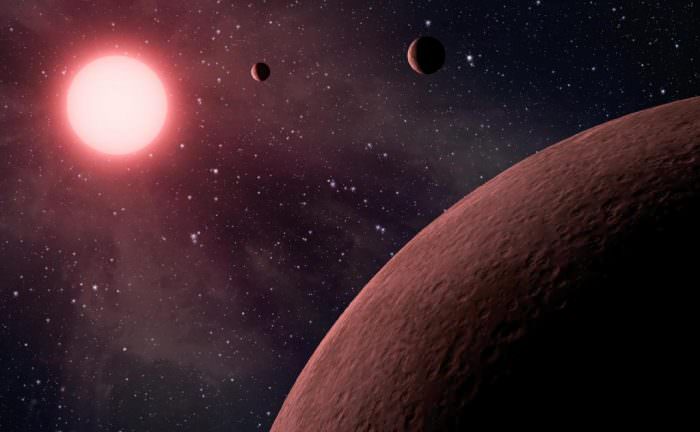 Finding exoplanets is hard work. In addition to requiring seriously sophisticated instruments, it also takes teams of committed scientists; people willing to pour over volumes of data to find the evidence of distant worl...
Our Guide to This Week's 'Ring of Fire' Annular Eclipse
Universe Today - 30 Aug 2016 11:50 In Africa this week? The final solar eclipse of 2016 graces the continent on Thursday, September 1st. This eclipse is annular only, as the diminutive Moon fails to fully cover the disk of the Sun. The 99.7 kilometer wide...
NASA's OSIRIS-REx Asteroid Sampling Probe Assembled at Florida Launch Base for Sep. 8 Blastoff -- Cleanroom Photos
Universe Today - 30 Aug 2016 05:45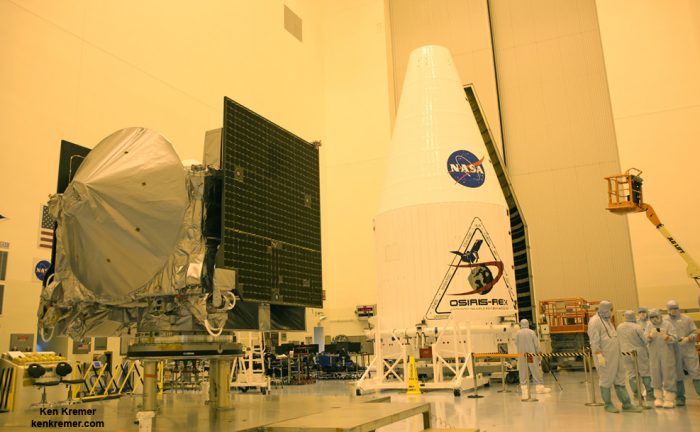 KENNEDY SPACE CENTER, FL - OSIRIS-Rex, the first American sponsored probe aimed at retrieving "pristine materials" from the surface of an asteroid and returning them to Earth has been fully assembled at its Florida launc...
An atypical protostar
Phys.org - 30 Aug 2016 15:20 At the centre of this image, captured by ESA's Herschel space observatory, is a truly peculiar cosmic object: a star named IRAS 19312+1950.
SETI detects possible signal at 11 GHz frequency from sun-like star
Phys.org - 30 Aug 2016 15:14 A star system 94 light years away is in the spotlight as a possible candidate for intelligent inhabitants, thanks to the discovery of a radio signal by a group of Russian astronomers.
Anomalous grooves on Martian moon Phobos explained by impacts
Phys.org - 30 Aug 2016 17:00 Some of the mysterious grooves on the surface of Mars' moon Phobos are the result of debris ejected by impacts eventually falling back onto the surface to form linear chains of craters, according to a new study.
Hurricanes Lester and Madeline Seen From Space
SpaceRef - 30 Aug 2016 03:15
Composite image of Hurricanes Madeline (left) and Lester (right) west of the Americas, from 06:00 (UTC) on Monday, 29 August 2016....
Who else is looking for new worlds around Proxima Centauri?
Phys.org - 30 Aug 2016 15:21 Finding exoplanets is hard work. In addition to requiring seriously sophisticated instruments, it also takes teams of committed scientists; people willing to pour over volumes of data to find the evidence of distant worl...
A Newfound Asteroid Just Buzzed Harmlessly By Earth
SPACE.com - 30 Aug 2016 13:00 The newfound asteroid 2016 QA2 zoomed within 50,000 miles (80,000 kilometers) or so of the planet Sunday. For perspective, the moon orbits Earth at an average distance of 239,000 miles (384,600 km).
Planet Nine could spell doom for solar system
e! Science News - 30 Aug 2016 16:44
The solar system could be thrown into disaster when the sun dies if the mysterious 'Planet Nine' exists, according to research from the University of Warwick.
Planet Nine --"Could Spell Doom for Our Solar System"
The Daily Galaxy - 30 Aug 2016 16:15
The solar system could be thrown into disaster when the sun dies if the mysterious 'Planet Nine' exists, according to research from the University of Warwick. Physicist Dimitri Veras at the University of Warwick has disc...
NASA Astronomers --"Baffled By Massive Age-Defying Star Deep in the Milky Way"
The Daily Galaxy - 30 Aug 2016 14:29
For years, astronomers have puzzled over a massive star lodged deep in the Milky Way that shows conflicting signs of being extremely old and extremely young. Researchers initially classified the star as elderly, perhaps ...
Researchers observe solar eclipse's effects on weather
Phys.org - 30 Aug 2016 13:10
When the Moon abruptly cuts off sunlight from Earth at a total solar eclipse, our weather reacts to the sudden darkness. A new issue of the Philosophical Transactions of the Royal Society of London, the oldest surviving ...
Spitzer Probes Peculiar Age-Defying Star
SpaceRef - 30 Aug 2016 03:13
For years, astronomers have puzzled over a massive star lodged deep in the Milky Way that shows conflicting signs of being extremely old and extremely young....
Irregular dimming of a young stellar object investigated by astronomers
Phys.org - 30 Aug 2016 15:10 (Phys.org)--New research conducted by a team of astronomers, led by Simone Scaringi of the Max Planck Institute for Extraterrestrial Physics in Germany, examines peculiar dimming of a newly found young stellar object des...
"Life's Cosmic Catalyst" --Meteorites Delivered the Backbone of DNA to Earth
The Daily Galaxy - 30 Aug 2016 15:00
Where terrestrial life on Earth got its phosphorus has been a mystery. University of Arizona scientists have discovered that meteorites, particularly iron meteorites, may have been critical to the evolution of life on Ea...
'Hibernating' Astronauts May Be Key to Mars Colonization
SPACE.com - 30 Aug 2016 13:00 Researchers are working on ways to induce a hibernation-like torpor state in astronauts -- a breakthrough they say is key to establishing a long-term colony on Mars.
Geospatial expert on newly discovered planet Proxima b
Phys.org - 30 Aug 2016 12:34 Last week, an international team of astronomers announced the discovery of a planet orbiting Proxima Centauri, our solar system's closest neighbor. Called Proxima b, the planet is 4.2 light years away from Earth--the clo...
An atypical protostar
ESA - 30 Aug 2016 10:45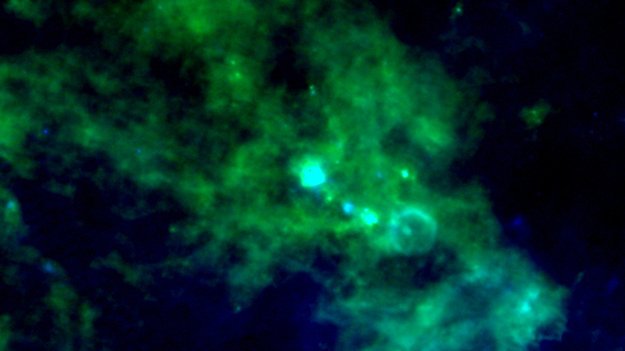 Space Science Image of the Week: A peculiar, age-defying star as seen by ESA's Herschel
First DNA Sequencing Conducted in Space
SpaceRef - 30 Aug 2016 03:17
For the first time ever, DNA was successfully sequenced in microgravity as part of the Biomolecule Sequencer experiment performed by NASA astronaut Kate Rubins this weekend aboard the International Space Station....
 Global
 Great Britain
 Indian
 South Africa