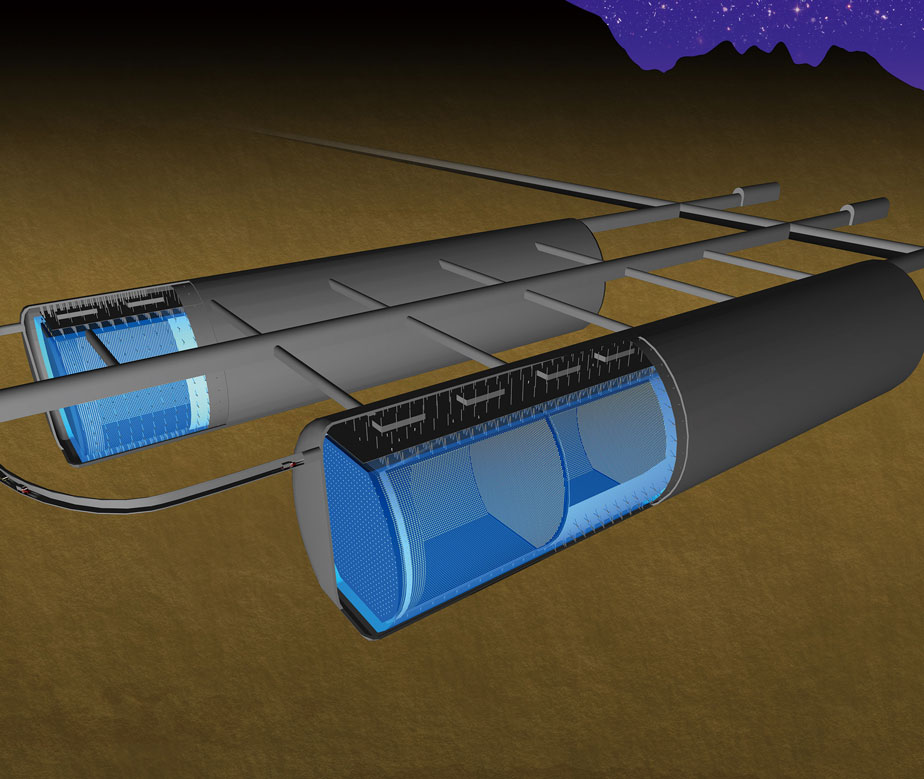
 The proposed Hyper-K experiment would dwarf its predecessor. In 1998, the Super-K detector in Japan revealed that ubiquitous, almost massless particles called neutrinos have the ability to morph from one type to another. That landmark finding has become one of the most heavily cited scientific results in particle physics. Now scientists have proposed to build a successor to the still-operating Super-K: Hyper-K, a detector with an active volume 25 times its size. Part microscope and part telescop...
The proposed Hyper-K experiment would dwarf its predecessor. In 1998, the Super-K detector in Japan revealed that ubiquitous, almost massless particles called neutrinos have the ability to morph from one type to another. That landmark finding has become one of the most heavily cited scientific results in particle physics. Now scientists have proposed to build a successor to the still-operating Super-K: Hyper-K, a detector with an active volume 25 times its size. Part microscope and part telescop...
The proposed Hyper-K experiment would dwarf its predecessor. In 1998, the Super-K detector in Japan revealed that ubiquitous, almost massless particles called neutrinos have the ability to morph from one type to another. That landmark finding has become one of the most heavily cited scientific results in particle physics. Now scientists have proposed to build a successor to the still-operating Super-K: Hyper-K, a detector with an active volume 25 times its size. Part microscope and part telescop...
Share this Article
Recommended