Science News
 American
Science News for 9 October 2017
American
Science News for 9 October 2017
Half the universe's missing matter has just been finally found
New Scientist - 9 Oct 2017 14:18
About half the normal matter in our universe had never been observed - until now. Two teams have finally seen it by combining millions of faint images into one
Clear lakes disguise impaired water quality
EurekAlert! - 9 Oct 2017 06:00
(University of Minnesota) Look at a hundred lakes in the United States' agricultural heartland and you'll likely see green lakes surrounded by green fields. Agricultural fertilizers that help crops grow also fuel growth ...
Single 'solitons' promising for optical technologies
Phys.org - 9 Oct 2017 22:46 Researchers are a step closer to harnessing single pulses of light called solitons, using tiny ring-shaped microresonators, in findings that could aid efforts to develop advanced sensors, high-speed optical communication...
Smartphone lets you see round corners by light flicker on floor
New Scientist - 9 Oct 2017 20:00
Tracking tiny variations in light reflected at the base of a wall can let you count people in a room and see where they are moving
Caught in the Act: The Quick Escape of Electrons
Physics Buzz - 9 Oct 2017 19:56
When hit with an energetic particle of light, an electron orbiting the nucleus of an atom can break free in less than one quadrillionth of a second. Exactly what happens during this fraction of a second is difficult to c...
Father of 'nudge' psychology wins economics Nobel
New Scientist - 9 Oct 2017 19:27
Richard Thaler has won this year's Nobel Prize in Economic Sciences for his work on the limits to human rationality and how to subtly influence people's behaviour
Cold climate may have driven ancient humans' move out of Africa
New Scientist - 9 Oct 2017 19:25
East Africa became colder and drier around 75,000 years ago, just when modern humans were apparently migrating out of Africa
Most science papers turn out to be wrong. It's time to fix that
New Scientist - 9 Oct 2017 19:19
Research findings often crumble under the microscope. Rows over the best way to fix this must end so we can stop trust in science crumbling too, says Robert Matthews
Evolution's rules mean life on Earth isn't that varied after all
New Scientist - 9 Oct 2017 19:18
While there are millions of species on Earth, many of them have almost identical lifestyles, suggesting nature is more regular and rule-based than we thought
Kuwait's plans for mandatory DNA database have been cancelled
New Scientist - 9 Oct 2017 18:22
Kuwait has revoked the world's first law requiring everyone to submit samples of their DNA, after a court found it would violate personal liberty
Nanoflares in the sun's plasma may cause its scalding atmosphere
New Scientist - 9 Oct 2017 18:00
Tiny explosions in the atmosphere may explain why the solar corona is a million degrees hotter than the sun's surface
How Technology Is Transforming the Way We Teach and Learn
Singularity Hub - 9 Oct 2017 17:00 Our education system is in need of reform. Most students are not taught to be self-motivated lifelong learners, nor do they come out of the school system with the skills, mindsets, and values required to survive a world ...
A zero-index waveguide: Researchers directly observe infinitely long wavelengths for the first time
Phys.org - 9 Oct 2017 17:00 In 2015, researchers at the Harvard John A. Paulson School of Engineering and Applied Sciences (SEAS) developed the first on-chip metamaterial with a refractive index of zero, meaning that the phase of light could be str...
Here Are 3 Good Reasons Why It's Time to Return to the Moon
Singularity Hub - 9 Oct 2017 16:00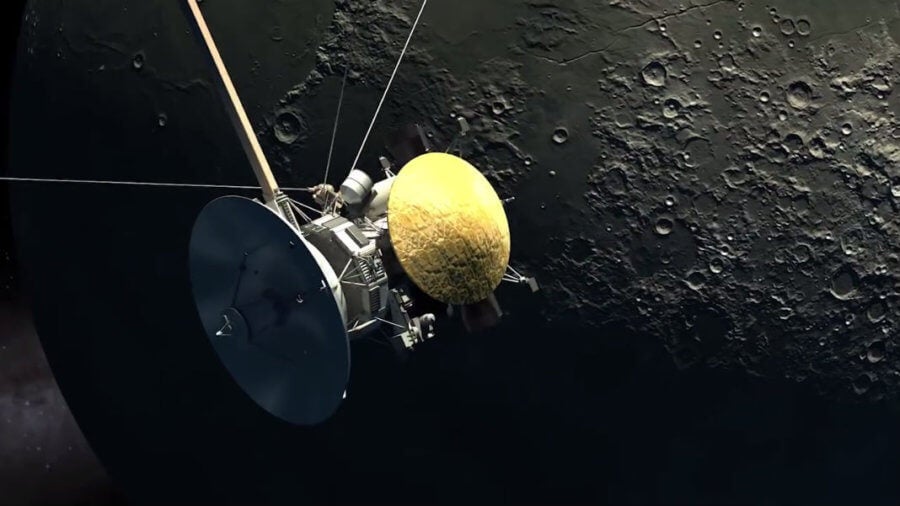 Since 1962 when President John F. Kennedy declared, "We choose to go to the moon in this decade,"moon exploration has sparked the imagination. Today, Peter Diamandis says, moon exploration is as exciting as Alaska was in...
Exploding stars could have kick-started our ancestors' evolution
New Scientist - 9 Oct 2017 15:52
The savannahs early hominins occupied might have appeared thanks to a spate of wildfires 8 million years ago - which might in turn be linked to a nearby supernova
Scientists address many-electron problem by modeling an infinite chain of hydrogen atoms
Phys.org - 9 Oct 2017 15:30 (Phys.org)--For the first time, scientists have determined the equation of state of an infinite chain of hydrogen atoms, which tells the amount of energy each hydrogen atom has, given the bond length between adjacent ato...
Light-filtering paint cools your home when exposed to hot sun
New Scientist - 9 Oct 2017 14:06
Laser cooling has been applied to paint, which could mitigate urban heat islands and solve the problem of how to cool objects in space
Here's How to Talk to Your Kids About Opioids
Live Science - 9 Oct 2017 13:56 Many parents don't think their child is at risk for misusing opioids. But the numbers suggest otherwise, and it's critical to prevent opioid use at a young age.
New Drug to Protect Infants from Whooping Cough Shows Promise
Live Science - 9 Oct 2017 13:55 A potential new drug might protect infants from whooping cough in their first few months of life, before they can be vaccinated, early research suggests.
End of the World As We Know It: What's the Draw of Dystopian Sci-Fi?
Live Science - 9 Oct 2017 13:53 Sci-fi and speculative fiction writers frequently imagine worlds rooted in social disintegration or even total collapse. What inspires these broken futures, and why are they so popular?
Nobel prizes would be better without all the fame and fortune
New Scientist - 9 Oct 2017 12:45
A Nobel prize brings big money and celebrity status for a few, but that's at odds with modern, collaborative science done for the greater good, says Geraint Lewis
ATLAS experiment studies fragments of the top quark
Phys.org - 9 Oct 2017 12:39 Top quarks in the Large Hadron Collider (LHC) proton-proton collisions are predominantly produced in pairs, with one top quark and one top antiquark. In order to measure the production rates of top quark pairs, the ATLAS...
 Global
 Great Britain
 Indian
 South Africa